.svg)

Reward the right people for meeting the rightmetrics.
Site managers play critical roles in both the contractsecurity and janitorial industries. They are entrusted to deliver on yourcontracts and keep your customers (and employees) happy. Naturally, you wantthem to do that in the most efficient way possible. One way you can insure yoursite managers are helping drive your business forward is to reevaluate how you incentivizethem so you’re rewarding based on a holistic picture of performance. Ratherthan focusing solely on job site profitability, take a look at employeeretention costs by site as well. That will give you a more accurate view of whoyour best performers are, and it can help you avoid some bad manager practicesthat can hurt your retention, too.
As strategic partners with end-to-end solutions specific to the janitorial and security industries, Kwantek and TEAM Softwaree know how important issues like retention and turnover are to your business. We hear it every day from our customers, prospects and industry partners. That’s why we’ve partnered in this five-part retention and turnover blog series to help you focus on the metrics and data that will improve your business.
Measuring Site Profitability Isn’t Enough
As a business owner, your instinct is to reward efficiency.Whether that’s in the form of speed, technique, or process, making anythingmore efficient is always a top priority. If you’re incentivizing your managers bylabor cost reduction or by job site profitability, don’t be surprised if theytake it to the extreme. Although it seems logical to reward the manager who made you the most money, thereare three unintended consequences of this incentivization strategy that make itunfit for your business.
- Managersstop giving raises: without regular raises, your retention will suffer, andyour top employees will realize they’re making the same amount as people who doless work.
- Managerscover missed shifts instead of focusing on quality control: knowing thatfewer employees doing the same job means higher profitability, they may betempted to cover shifts for no-show employees rather than bringing somebody in.
- Managers overwork existing employees:increased demands can lead to a lack of appreciation and a feeling of beingused from your very best employees.
Each of these issues negatively impacts employee retentionand your company’s long-term profitability. In theory, you should absolutelyreward your site managers based on job site profitability. But, you should alsofactor in the costs of hiring at that site. We discussed how to calculate yourcosts per hire and why that figure is important in our lastblog post. As hiring costs move into the four-figure territory, yourincentivization strategy should include how many hires site managers needed tomake throughout the year.
Not surprisingly, we found an overwhelming majority ofcompanies in the janitorial and security industries calculate annual bonusesfor site managers based on net profit at the site level, where net profit iscalculated as site revenue minus payroll costs.
Let’s use the following example to see why that’s not thebest way to calculate site manager bonuses:
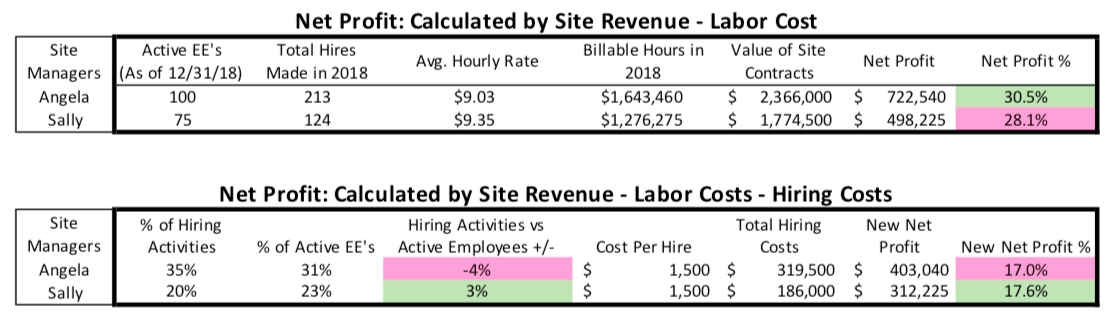
On the surface, Angela appears to be the most profitablemanager. She has the highest percentage of net profit after calculating thedifference between billable hours and the value of her site contracts. Shewould receive the largest bonus of any site manager and would be rewarded forher efforts.
However, a closer look at her hiring habits tells adifferent story. Angela had the worst turnover rate. She continued to makehires, and despite her lower average hourly rate, her net profitabilityplummeted after calculating her total hiring costs.
Conversely, Sally had the worst net profit percentage beforecalculating hiring costs. But, thanks to improved retention, Sally was able tohire fewer employees giving her a higher profit margin than Angela afterfactoring in the hiring costs.
Hiring Costs + Site Profitability = A More Complete Picture
Integrated job costing software makes it easy to determineyour profitability by job site. For manager incentivization strategies, however,if you’re not associating hiring and admin costs by manager in addition to sitelevel profitability, you may not have the full picture of your managers’ impacton profitability. It’s no secret that turnover and retention issues hurtprofitability in general, but don’t forget the impact at the site level. Youcould be financially rewarding managers for actions that hurt your overallprofitability.
In the next post in this blog series co-written with Kwantek, we will dive deeper into the top metrics to focus on when evaluating the effectiveness of your site managers. In the meantime, you can get caught up with our earlier posts in the series on calculating cost per hire and the difference between retention and turnover.
Other posts in this series can be found below: